Synopsis
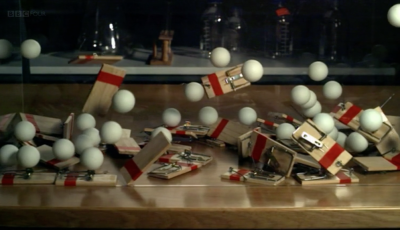
Spec references J248: C2.2di, C2.2e, C2.2f J250: C2.2di, C2.2e, C2.2f. Ideal for topic revision, this video explains how ions are formed through the loss and gain of electrons. It covers the differences in how metals and non-metals react, focusing on electron transfer. The video also explains how ion charges result from an imbalance between protons and electrons and relates the charge of ions to their group number. Additionally, it introduces the concept of ionic bonding, emphasising electrostatic forces of attraction and the use of dot and cross diagrams. A brief introduction to ionic formulae is also provided.
- Programme: GCSE Bitesize Revision
- Episode: Additional Science 1
- Channel: BBC Two
- Broadcast year: 2010
-
Chemistry (J248):C2.2di, C2.2e, C2.2f
Combined Science (J250): C2.2di, C2.2e, C2.2f
Licence: ERA Licence required
UK only
Staff and students of licensed education establishments only
Cannot be adapted
Add Notes
More clips from GCSE Bitesize Revision
Acceleration | Additional Science 1
Spec references J249: P2.1h J250: P2.1h. Calculating acceleration and what the units mean - description and animation.
Acids, Bases and Salts | GCSE Bitesize Revision
Spec references J248: C3.3d, C3.3e, C3.3f, C3.3h, C4.2a J250: C3.3d, C3.3e, C3.3f, C3.3h, C3.1g. This video introduces acids ...
Acids, Bases and Salts 2 | GCSE Bitesize Revision
Spec references J248: C3.3d, C3.3e, C3.3f, C3.3h, C4.2a J250: C3.3d, C3.3e, C3.3f, C3.3h, C3.1g. This video introduces acid...
Atomic Structure - Revision | GCSE Bitesize Revision
Spec references J248: C1.2b, C1.2d, C1.2e J250: C1.2b, C1.2d, C1.2e. A fast-paced overview of the basics of atomic struc...
Cell Division | GCSE Bitesize Revision
Animated shorts to support students preparing for assessments in GCSE Additional Science.
Diffusion and Osmosis | GCSE Bitesize Revision
Spec references J247: 2.1a J250: 2.1a. Animated shorts to support students preparing for assessments in GCSE Additional Science.
Distance-time graphs | Additional Science 1
Spec references J249: P2.1b J250: P2.1b. Description and animation. Distance time graphs.
Enzymes and Digestion | GCSE Bitesize Revision
Animated shorts to support students preparing for assessments in GCSE Additional Science.
Homeostasis | GCSE Bitesize Revision
Spec references J247: B3.3a, B3.3b, B3.3c, B3.3d, B3.3e, B3.3g, B3.3j. Higher paper content for homeostasis. Structure of the kidney, ho...
How enzymes work | GCSE Bitesize Revision
Spec references J247: B1.2g J250: B1.2d. How enzymes break down substrates into products, lock and key model, denaturing of protein...
Introduction to Covalent Bonding | GCSE Bitesize Revision
This video introduces covalent bonding, focusing on electron sharing, the use of dot and cross diagrams, and exampl...
Kinetic energy | Additional Science 1
Spec references J249: P7.1e J250: P5.1e. Animation, description and worked example. Kinetic energy.
Kinetic Energy And Momentum | GCSE Bitesize Revision
Animated shorts to support students preparing for assessments in GCSE Additional Science.
Measuring the Rate of Reaction | GCSE Bitesize Revision
Spec references J248: C5.2a, C5.2c, C5.2d, C5.2e, C5.2f J250: C5.2a, C5.2c, C5.2d, C5.2e, C5.2f. This video provides ...
Mitosis, meiosis and reproduction | GCSE Bitesize Revision
Spec references J247: B2.1b, B5.1f, B5.1h J250: B2.1b, B5.1f. Different steps of mitosis, asexual reproduction, di...
Momentum | Additional Science 1
Spec references J249: P2.2k J250: P2.2k. Animation, description and worked example, p = m v. Description of force = rate of change of momentu...
Representing Motion | GCSE Bitesize Revision
Animated shorts to support students preparing for assessments in GCSE Additional Science.
Speed | Additional Science 1
Spec references J249: P2.1h J250: P2.1h. Calculating speed and units of speed - description and animation.
Velocity-time graphs | Additional Science 1
Spec references J249: P2.1e J250: P2.1e. Description and animation. Velocity time graphs.
Work done | Additional Science 1
Spec references J249: P2.2m, P7.1c, P7.1d J250: P2.2l, P5.1c, P5.1d. Animation, description and worked example. Work done = force × distance.
More resources about Chemistry
2: The Order of the Elements | Chemistry: A Volatile History
Professor Jim Al-Khalili looks at how the early scientists' bid to decode the order of the elements was driven b...
Episode 3 | Planet Oil: The Treasure That Conquered The World
Professor Iain Stewart examines the situation in the 21st century, at which point the global consumption of oil...
Episode 1 | Planet Oil: The Treasure That Conquered The World
From the moment we first drilled for oil, we opened a Pandora's box that changed the world forever. It transfor...
1: Discovering the Elements | Chemistry: A Volatile History
The story of how the elements were discovered and mapped begins with the alchemists who questioned that the world...
3: The Power of the Elements | Chemistry: A Volatile History
Jim Al-Khalili reveals the breakthroughs which harnessed elements' ability to release vast power, showing how sc...
Atomic Structure - Building an Atom | Curriculum Bites
Spec references J248: C1.2b, C1.2d, C1.2e J250: C1.2b, C1.2d, C1.2e. How can an atom be completely described by the in...
Carbon capture and storage | Planet Oil: The Treasure That Conquered the World
Professor Iain Stewart investigates CCS, a process that is attempting to reduce carbon dioxide...
Carbon footprint of a loaf of bread | Royal Institution Christmas Lectures
Dr Tara Shine discusses the carbon emissions from the process of baking a loaf of bread.
Ceramics | How It Works
Professor Mark Miodownik looks at how simple clay, sand and rock can be changed into pottery, glass and concrete to build cities and transform the wa...
Climate refugees | Black Black Oil
Hundreds of millions of people are expected to migrate from their countries by 2050 due to rising sea levels.
Electrolysis - Discovery of Potassium | Curriculum Bites
Spec references J248: C3.4b J250: C3.4b. Professor Jim Al-Khalili recreates the electrolysis experiment that lead to...
Endothermic and exothermic reactions | Bitesize Science
Endothermic reactions absorb heat, while exothermic reactions give off heat.
Episode 2 | Planet Oil: The Treasure That Conquered The World
Professor Iain Stewart looks back at the 1950s, a time when the oil and gas fields of the Middle East became a ...
Fracking | Planet Oil: The Treasure That Conquered the World
Professor Iain Stewart explains the process of fracking.
How are elements made? | Wonders of the Universe
Brian Cox explains what elements are and how they are formed, including the importance of carbon.
Metal | How It Works
Mark Miodownik traces the history of our love affair with metal. He investigates metals at the atomic level and sees how metal crystals can be grown to ...
Plastic | How It Works
Mark Miodownik shows how plastics have brought luxury to the masses and reveals how the next generation will take its inspiration from nature and coul...
Production of Plastic from Crude Oil | Real World Chemistry
Spec references J248: C6.2m, C6.2n, C6.2o J250: C6.1k, C6.1l, C6.1m. This clip demonstrates how plastic is produc...
Properties of Group 1 Metals | Chemistry: A Volatile History
Spec references J248: C4.1a. Demonstration of reactions of lithium, sodium and potassium with water (Contains hi...
Rates of reaction | Curriculum Bites
Spec references J248: C5.2c, C5.2d, C5.2e, C5.2f J250: C5.2c, C5.2d, C5.2e, C5.2f. Introduction to rate of chemical reactions and collis...