Duration: 1'59''
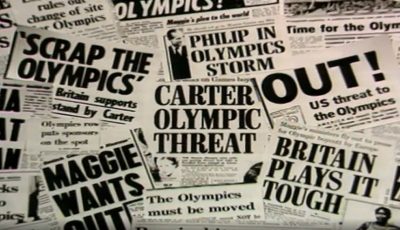
British athletes recall facing the decision on whether to attend the games.
Licence: ERA Licence required
UK only Staff and students of licensed education establishments only Cannot be adapted
Add Notes
Boycott by the United States | Moscow 1980: The Cold War Olympics
As politics and sport collided head on, athletes faced tough dilemmas.
Moscow 1980: The Cold War Olympics
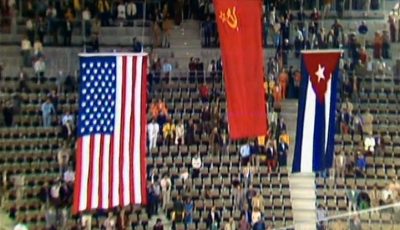
Steve Cram recalls how the Moscow Olympics of 1980 came to symbolise the intensity of the Cold War. As politics and sport collided head on...
Moscow 1980: The Cold War Olympics | Moscow 1980: The Cold War Olympics
Steve Cram recalls how the Moscow Olympics of 1980 came to symbolise the intensity of the Cold War.
1: Berlin 1945-48 | History File
Compilation of secondary schools programme about the Cold War, featuring Berlin Crisis, Hungarian Uprising, rise of Soviet leader Nikita Khr...
1: Deja Vu (1858-1961) | The Vietnam War
Revolutionaries led by Ho Chi Minh end French colonial occupation. Vietnam is divided in two at Geneva.
1: Lyndon Johnson's War | Wheeler on America
A look back at the classic series Wheeler on America from 1996. Charles Wheeler traces changes in US society since the liberal r...
10: Cuba: 1959-1962 | Cold War
Fidel Castro comes to power following the Cuban Revolution. Cuba aligns itself with the Soviet Union and the government starts nationalising A...
10: The Weight of Memory (March 1973-Onward) | The Vietnam War
While Watergate forces Nixon to resign, the Vietnamese continue to savage one another.
11: 1945: Brave New World | People's Century
Despite being allies against Hitler, disagreement and rivalry soon break out between the Soviet Union and the West, leading to t...
11: The Cold War Confrontation | Twentieth Century History
The Berlin blockade of 1948-49 and the Korean War 1950-53.
11: Vietnam: 1954-1968 | Cold War
After losing the Battle of Dien Bien Phu the French leave Vietnam. A stream of refugees flee to the south after the Communist north institu...
12: 1948: Boomtime | People's Century
Europe is exhausted and impoverished in the years after the Second World War. The United States implements the Marshall Plan to rebuild...
12: MAD: 1960-1972 | Cold War
The United States nuclear strategy of counterforce, intended to counter a Soviet conventional attack by targeting military facilities, is discr...
12: Mr Kennedy and Mr Khruschev | Twentieth Century History
The contest between the United States and the Soviet Union between 1961 and 1963 leading to the Cuban Missile Cri...
14: Red Spring: 1960s | Cold War
Likewise the Soviet Union started the decade with growing openness and optimism. There was also an emerging cohort of youth with no memory o...
15: 1951: Asia Rising | People's Century
Through thrift, hard work and discipline, Japan and later South Korea enjoy economic miracles that bring growth, prosperity and conf...
15: China: 1949-1972 | Cold War
Following the Chinese Revolution Mao Zedong aligns China firmly with the Soviet Union. China becomes the recipient of Soviet aid, supports Co...
16: Détente: 1969-1975
Nixon builds closer relations with China and the USSR, hoping to leverage an honourable US exit from Indochina. The Soviet Union is fearful of a US-C...
17: Good Guys, Bad Guys: 1967-1978 | Cold War
Under Détente the superpowers continued their rivalry, but carefully avoided direct conflict by courting allies in the developi...
18: Backyard: 1954-1990 | Cold War
The United States saw the emergence of leftist movements in different Latin American countries as threatening to its commercial interests,...
19: Freeze: 1977-1981 | Cold War
Carter's ambitious proposals for total multilateral nuclear disarmament are rejected by Brezhnev; his championing of human rights does not w...
2: Hungary 1956 | History File
Compilation of secondary schools programme about the Cold War, featuring Berlin Crisis, Hungarian Uprising, rise of Soviet leader Nikita Khrus...
2: Iron Curtain: 1945-1947 | Cold War
The wartime allies demobilise - the United States enjoys its economic strength and resurgence while Britain and the rest of Europe is e...
Cookies help us run our services and give you a better experience. For the full details please read our Cookie Policy.